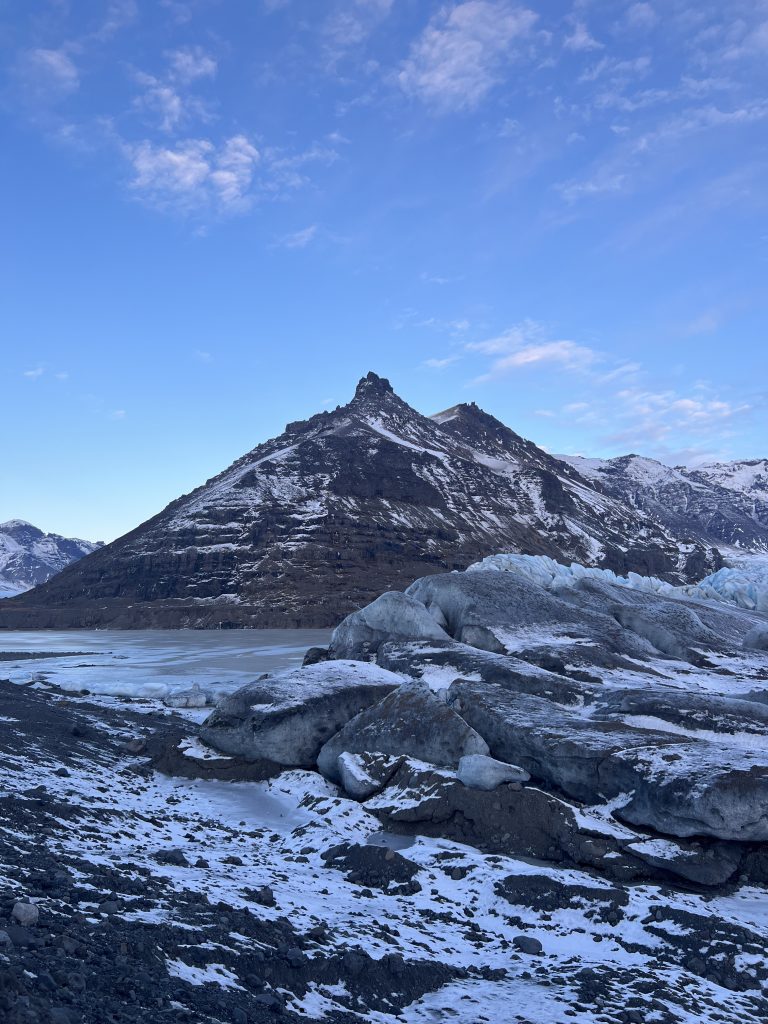
When we arrived at Svinafellsjökull, sunset was approaching. The light was slowly softening and the surface of the glacier was shifting between shades of gray, blue, and silver. Although it seemed quiet and motionless at first glance, when you stopped and looked a little longer, it gave you the feeling that you were actually inside a constantly working system.

Svinafellsjökull is located in southeastern Iceland and is one of the arms of Vatnajökull, Europe’s largest ice cap. This glacier which breaks off from the main ice mass and flows down the valley is an excellent example for understanding Iceland’s glacial structure.

Most people imagine glaciers as huge, frozen, immovable masses. The reality is quite different. Glaciers are actually living systems. Every year snow falls, accumulates, compacts, and eventually turns into ice. The ice begins to flow downward very slowly under its own weight. Svinafellsjökull is a place where this process has been ongoing for years.


As you walk, you notice that the glacier isn’t just staying in one place; it’s also shaping its surroundings. It’s eroding the rocks it passes over, deepening the valleys and gradually changing the landscape. Many of Iceland’s valleys, rivers, and lakes are actually the result of these long glacial movements.
The dark lines visible on the surface of the glacier may look like dirt at first glance. But these are layers of ash left over from volcanic eruptions in the past. Thanks to Iceland’s volcanic structure, these ash layers have formed timelines within the glacier. Each line carries a story from hundreds of years ago.


The glacial lake in front of Svinafellsjökull is also remarkable. This lake is a natural area formed by melting ice. When I was there, its surface was completely frozen. It looked like glass but the cracks on the surface clearly showed that the ice was still moving. Beneath this seemingly calm area, constant pressure and change continue.
Here, you understand more clearly why glaciers are so important for nature. Glaciers are one of the largest reservoirs of fresh water. Melting glacier water feeds rivers, carries minerals to the soil, and ensures the continuity of many ecosystems. At the same time, they act as a natural balancing element, reflecting sunlight and slowing down the warming of the planet.


However glaciers are not only beautiful and educational but also dangerous areas. Water channels, cavities, and weak spots can be found beneath the surface. Sudden ice breaks, collapses, and rapid changes in weather conditions can cause serious dangers. That is why guided glacier walks are generally recommended in Iceland. This is not a place to challenge nature, but an area where one must be in harmony with nature.


Svinafellsjökull is also one of the places where climate change can be observed very clearly. Looking at old photographs, you can see that the glacier used to extend much further into the valley. Today, parts of those areas are now covered in bare rock and gravel. The glacier is quietly retreating.
Standing here, you realize that Svinafellsjökull is not just a landscape. It is also a reminder. A living example of how powerful yet equally fragile nature is.

Many places in Iceland can be impressive, but some places teach you something.Svinafellsjökull is one of them.
Quiet, slow, and patient, like a teacher.